Swiss watches are known around the world for quality and precision. But in the 1800s, watchmaking in Switzerland was very different from today. Many small workers made parts at home, and watches were put together later by someone else. There was no single factory controlling the whole process.
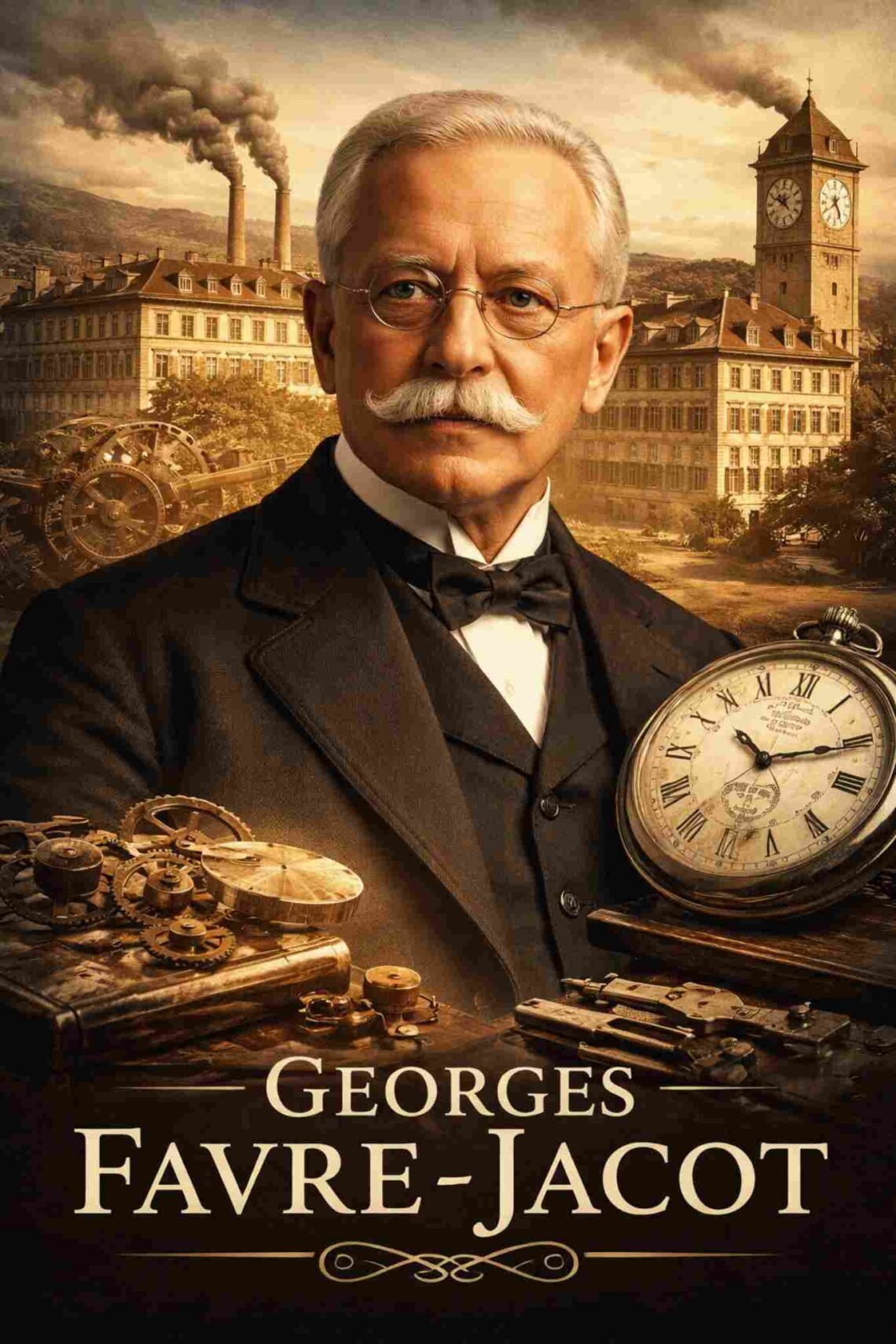
One man changed this system. His name was Georges Favre-Jacot. He helped create a new way of making watches. His ideas shaped the future of Swiss watchmaking.
1. Early Life
Basic Information
| Detail |
Information |
| Name |
Georges Favre-Jacot |
| Born |
December 12, 1843 |
| Birthplace |
Le Locle, Switzerland |
| Died |
May 19, 1917 |
| Job |
Watchmaker and business founder |
Georges Favre-Jacot was born in Le Locle, a town famous for watchmaking. He grew up around watchmakers and learned the trade at a young age.
As a young apprentice, he saw how watches were made in many small workshops. Different people made different parts. This system worked, but it had problems.
Problems in the Old System
-
Parts were made in different places
-
Quality was not always the same
-
Work was slow and hard to organize
-
It was difficult to improve quickly
Favre-Jacot believed there was a better way.
2. Starting His Own Workshop (1865)
In 1865, when he was only 22 years old, he started his own workshop. It was first called Fabrique des Billodes.
His goal was simple:
-
Make very accurate watches
-
Control every step of production
-
Improve quality
-
Build a strong and organized company
This was a big idea at the time.
3. His Big Idea: One Factory, One Team
Favre-Jacot decided to bring all watchmaking steps into one building. Instead of sending work to many small workshops, everything would happen under one roof.
This idea is called vertical integration.
Old System vs. New System
| Old Way |
Favre-Jacot’s Way |
| Many small workshops |
One large factory |
| Parts made separately |
Parts made together |
| Hard to control quality |
Strong quality control |
| Slow communication |
Faster teamwork |
What Was Made Inside the Factory
-
Watch movements
-
Gears and small parts
-
Dials
-
Cases
-
Final assembly
-
Testing and adjustment
By doing everything in one place, he improved quality and speed.
4. Growth of the Factory
His company grew quickly.
Reasons for Success
By the early 1900s:
-
The factory was very large
-
Thousands of people worked there
-
The brand became known in many countries
Favre-Jacot showed that watches could be made in a modern and organized way.
Read also: Kintaro Hattori
5. The Name “Zenith”
Favre-Jacot later chose the name “Zenith” for his brand.
The word “zenith” means the highest point in the sky. He wanted his watches to represent the highest level of quality.
Why the Name Was Important
Major Achievement
| Year |
Event |
| 1900 |
Won Grand Prize at Paris World Exhibition |
Winning this prize made the brand famous around the world.
6. His Leadership Style
Favre-Jacot was a strong and organized leader.
His Main Beliefs
-
Quality is more important than speed
-
Good teamwork brings better results
-
Strong structure improves success
-
Every part must meet high standards
He believed that good organization helps creativity and skill grow.
7. Building a Villa
Because of his success, he was able to build a beautiful home.
In 1912, he hired a young architect who later became famous as Le Corbusier.
About the Villa
| Detail |
Information |
| Built |
1912–1913 |
| Location |
Le Locle |
| Architect |
Le Corbusier |
| Meaning |
Symbol of success and modern thinking |
The villa showed that Favre-Jacot supported new and modern ideas—not only in watches, but also in design.
8. Later Years
As the company became bigger, it also became more complex. Over time, management changed. Favre-Jacot was no longer directly leading the company in his final years.
He died in 1917. By that time, his company had already become one of Switzerland’s most important watch factories.
9. His Impact on Watchmaking
Georges Favre-Jacot changed how watches were made in Switzerland.
His Long-Term Contributions
-
Created one of the first fully integrated watch factories
-
Improved quality control
-
Made production faster and more organized
-
Helped Swiss watches become world-famous
-
Set standards still used today
Before and After His Innovation
| Before Him |
After Him |
| Small home workshops |
Large organized factory |
| Limited control |
Full production control |
| Uneven quality |
Strong quality standards |
| Local focus |
Global reputation |
Today, many top watch brands proudly say they make their watches “in-house.” This idea became popular because of pioneers like Favre-Jacot.
10. His Legacy Today
His name is still respected in the watch world. Special watches have been made to honor him. But his true legacy is not just in the name.
His real legacy is:
-
Smart organization
-
Strong leadership
-
Belief in improvement
-
Focus on precision
-
Long-term vision
He proved that success comes from planning, discipline, and high standards.
Conclusion
Georges Favre-Jacot was more than a watchmaker. He was a thinker and a builder of systems. At a young age, he saw problems in the watch industry and decided to fix them.
By bringing all parts of production into one factory, he changed Swiss watchmaking forever. His idea of working “under one roof” helped create better watches and stronger companies.
Today, Swiss watches are known for quality and precision. A big reason for this reputation goes back to the work of Georges Favre-Jacot — a man who aimed for the highest point, just like the name he chose: Zenith.