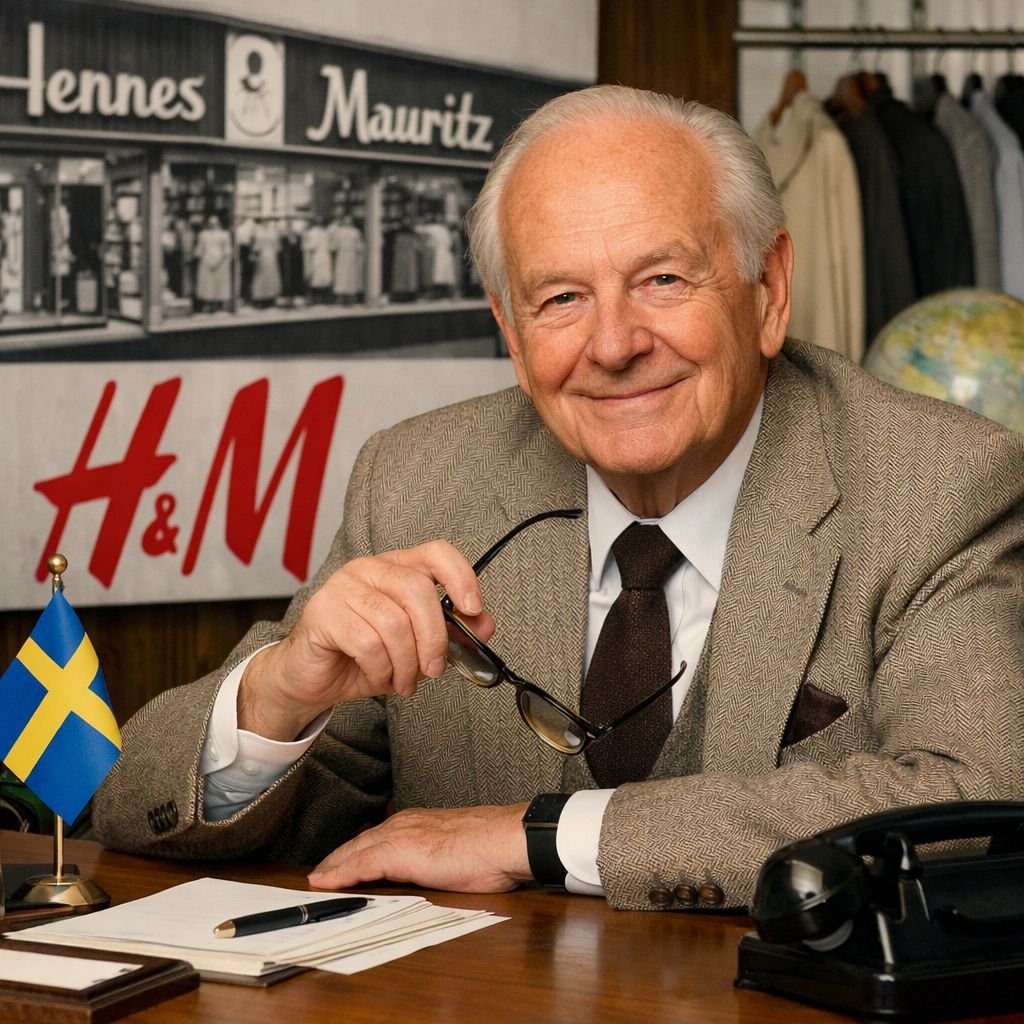
Erling Persson was a Swedish businessman who founded H&M (Hennes & Mauritz), one of the largest fashion retail companies in the world. He is known for changing the clothing industry by offering fashionable clothes at affordable prices. His business idea made stylish clothing available to millions of people. Before his idea, fashionable clothing was often expensive and limited to a small group of customers. Persson believed that everyone should be able to buy modern and stylish clothes without spending too much money. Because of this vision, he created a new business model that later became known as fast fashion. Today, H&M operates thousands of stores around the world and is one of the most recognized brands in global fashion retail. The success of H&M started with the simple but powerful idea of Erling Persson.
Early Life and Background
Erling Persson was born on January 21, 1917, in Rågdalen, Sweden. He grew up in Sweden and developed an interest in business from a young age. Before starting his own company, Persson worked in retail. This work experience helped him learn how stores operate and how customers shop for products.
Some important skills he learned early in his career included:
-
Understanding customer needs
-
Managing retail stores
-
Selling products effectively
-
Running a business efficiently
These skills helped him later when he started his own company.
Personal Information
| Detail | Information |
|---|---|
| Full Name | Erling Persson |
| Birth Date | January 21, 1917 |
| Birthplace | Rågdalen, Sweden |
| Nationality | Swedish |
| Profession | Entrepreneur |
| Known For | Founder of H&M |
| Death | October 28, 2002 |
Inspiration for a New Business Idea
After World War II, Persson traveled to the United States. During his trip, he visited many American retail stores. He noticed that these stores sold fashionable clothes at affordable prices. American retailers used large-scale production and efficient distribution to keep costs low. This allowed them to offer stylish clothing to many people. Persson believed that the same idea could work in Sweden and Europe.
Things Persson Observed in the United States
-
Large clothing stores
-
Affordable fashion for everyday people
-
Efficient supply chains
-
Mass production of clothing
-
Strong focus on customer demand
This experience gave Persson the idea to start his own clothing business.
Opening the First Hennes Store in 1947
In 1947, Erling Persson opened his first clothing store in Västerås, Sweden. The store was named Hennes, which means “hers” in Swedish. The store sold only women’s clothing. Persson focused on offering trendy clothes at prices that most people could afford. Customers liked the idea because they could buy fashionable clothing without paying very high prices.
Key Features of the First Hennes Store
-
Sold only women’s clothing
-
Focused on modern fashion trends
-
Offered affordable prices
-
Targeted everyday customers
The store quickly became popular. Because of this success, Persson began opening more stores across Sweden.
The Creation of Hennes & Mauritz (H&M)
In 1968, Persson bought a Swedish company called Mauritz Widforss. This company sold hunting and outdoor clothing. After buying the company, Persson expanded his clothing business to include men’s clothing and children’s clothing. The company was then renamed Hennes & Mauritz, which later became known worldwide as H&M.
Changes After the Acquisition
-
Added clothing for men
-
Introduced children’s clothing
-
Expanded product categories
-
Changed the company name to Hennes & Mauritz
This decision helped the company grow faster and reach more customers.
Read also: Abraham-Louis Breguet
Major Milestones in H&M’s Growth
| Year | Event |
|---|---|
| 1947 | First Hennes store opened in Västerås |
| 1952 | Expansion to Stockholm |
| 1968 | Mauritz Widforss acquired |
| 1968 | Company renamed Hennes & Mauritz |
| 1970s | Expansion into European countries |
| 1990s | International growth |
| 2000s | H&M becomes a global brand |
These milestones show how the company grew from a small store into a worldwide fashion retailer.
Expansion and Global Success
After becoming successful in Sweden, H&M started opening stores in other countries. The company expanded across Europe and later entered markets around the world. H&M’s growth was based on several simple business strategies.
Key Strategies Behind H&M’s Success
-
Offering affordable clothing
-
Following current fashion trends
-
Producing clothing in large quantities
-
Efficient supply chain management
-
Opening stores in popular locations
These strategies helped H&M compete with both luxury brands and traditional clothing retailers.
Global Presence of H&M
| Category | Information |
|---|---|
| Headquarters | Stockholm, Sweden |
| Industry | Fashion Retail |
| Countries Served | 70+ |
| Products | Clothing, accessories, footwear |
| Stores Worldwide | Thousands of stores |
H&M is now one of the largest clothing retailers in the world.
Leadership and Family Involvement
Erling Persson managed the company during its early years and helped build its strong foundation. Later, leadership of the company passed to his son Stefan Persson. Under his leadership, H&M expanded even more internationally.
Leadership Timeline
| Leader | Role | Contribution |
|---|---|---|
| Erling Persson | Founder | Started H&M and built the company |
| Stefan Persson | CEO/Chairman | Expanded the brand worldwide |
| Karl-Johan Persson | CEO | Modernized operations and growth |
The Persson family still plays an important role in the company today.
Business Philosophy of Erling Persson
Erling Persson believed in simple but powerful business ideas.
Core Principles of His Business Model
-
Fashion for Everyone
He believed stylish clothing should be available to all people. -
Affordable Prices
Keeping prices low allowed more people to buy fashionable clothes. -
Efficient Production
Producing clothing in large quantities helped reduce costs. -
Customer Focus
Understanding customer needs was very important. -
Following Fashion Trends
The company kept up with changing styles and trends.
These ideas helped H&M become a leader in the fashion industry.
Philanthropy and Social Contributions
Erling Persson’s legacy also includes charitable work. Several foundations connected to the Persson family support research and social projects.
Important Foundations
| Foundation | Purpose |
|---|---|
| Erling-Persson Foundation | Supports scientific research and education |
| H&M Foundation | Supports sustainability and social development |
These foundations help fund projects in areas such as:
-
Medical research
-
Education programs
-
Environmental sustainability
-
Community development
Legacy and Influence on the Fashion Industry
Erling Persson changed how clothing is sold around the world. His idea of selling fashionable clothing at affordable prices influenced many other fashion companies.
Major Contributions
-
Created a global fashion brand
-
Introduced affordable fashion retail
-
Helped develop the fast fashion business model
-
Made trendy clothing available to millions of people
Today, many fashion companies use similar strategies.
Death and Lasting Impact
Erling Persson died on October 28, 2002, at the age of 85. By that time, H&M had already become a major international clothing brand. Even after his death, his business ideas continue to shape the fashion industry.
Why Erling Persson Is Remembered
-
Founder of H&M
-
Pioneer of affordable fashion
-
Influential retail entrepreneur
-
Creator of a global fashion company
Quick Facts About Erling Persson
| Fact | Details |
|---|---|
| Born | January 21, 1917 |
| Birthplace | Sweden |
| First Store | Hennes (1947) |
| Company | Hennes & Mauritz (H&M) |
| Major Expansion | 1968 acquisition of Mauritz Widforss |
| Industry | Fashion Retail |
| Died | October 28, 2002 |
Conclusion
Erling Persson’s story shows how a simple idea can change an entire industry. By offering fashionable clothing at affordable prices, he built one of the most successful clothing companies in the world. From a single store in Sweden to thousands of stores worldwide, the growth of H&M reflects Persson’s vision and determination. His ideas continue to influence the global fashion industry today. The legacy of Erling Persson lives on through H&M, the Persson family, and the millions of customers who enjoy stylish clothing at affordable prices.