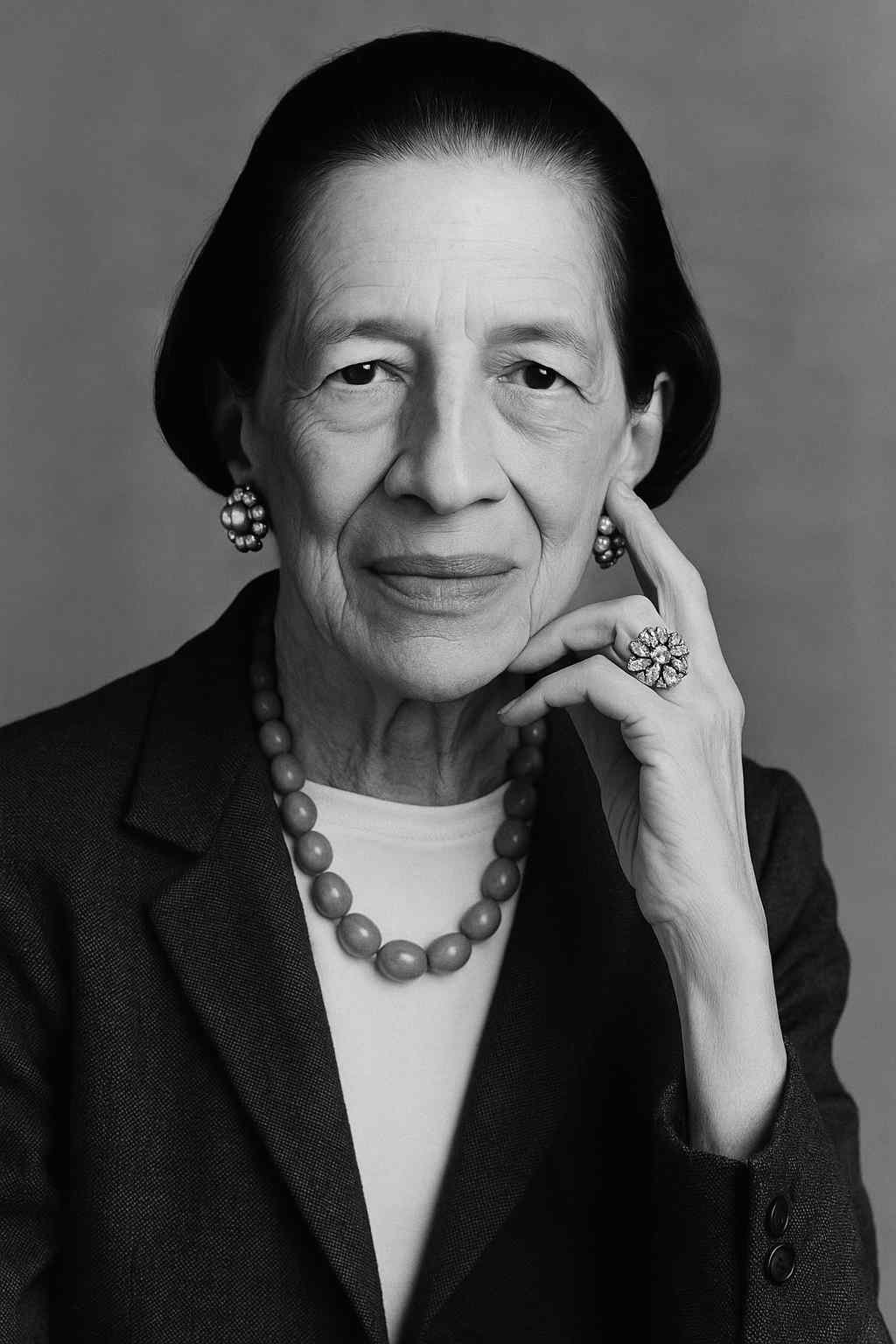
Diana Vreeland was one of the most powerful and creative women in the history of fashion. She was not a designer or model, but she had an incredible eye for style. Through her work at Harper’s Bazaar, Vogue, and the Metropolitan Museum of Art, she changed how people think about beauty, creativity, and self-expression.
1. Early Life
Quick Facts:
| Detail | Information |
|---|---|
| Full Name | Diana Dalziel Vreeland |
| Born | July 29, 1903 – Paris, France |
| Died | August 22, 1989 – New York City, USA |
| Nationality | American |
| Famous For | Fashion editor and museum curator |
| Famous Quote | “The eye has to travel.” |
Diana was born in Paris to an American mother and a Scottish father. She grew up around music, art, and fashion. She studied dance when she was young and learned to love movement, color, and rhythm.
Her family moved to New York during World War I. Later, she married a banker named Reed Vreeland and moved to London. There she met many stylish and creative people and began developing her own bold and unique fashion sense. When she returned to New York, she stood out for her confidence and flair.
2. The Harper’s Bazaar Years (1936–1962)
Diana’s career in fashion started by chance. One night, while dancing in a club, she caught the eye of Carmel Snow, the editor of Harper’s Bazaar. Snow was so impressed with her style that she offered her a job at the magazine.
That’s how Diana became a columnist and started her famous section called “Why Don’t You…?”
Her “Why Don’t You…?” Column
This column was full of fun and unusual ideas like:
-
“Why don’t you wash your child’s hair in champagne?”
-
“Why don’t you have a lemon tree in your living room?”
-
“Why don’t you wear violet velvet gloves?”
She didn’t expect readers to do these things — she wanted them to dream big and think creatively.
Her Main Achievements at Harper’s Bazaar
-
Brought imagination and fun to fashion writing.
-
Worked with top photographers and stylists.
-
Promoted the idea that everyone can have their own style.
-
Helped create the modern idea of fashion photography.
Key Collaborators:
| Collaborator | Role / Impact |
|---|---|
| Richard Avedon | Created lively, moving fashion photos with her. |
| Louise Dahl-Wolfe | Brought warmth and color into magazine pages. |
| Alexey Brodovitch | Art director who supported her creative ideas. |
Diana stayed at Harper’s Bazaar for over 25 years. Her work made the magazine fun, exciting, and inspiring. She showed that fashion could be about fantasy, not just clothing.
Read also: Heidemarie Jiline “Jil” Sander
3. Vogue and the Age of Imagination (1963–1971)
In 1963, Diana became Editor-in-Chief of Vogue. It was the 1960s — a time of youth, color, and change. She turned the magazine into a creative explosion.
Her Style at Vogue
-
Color and culture: She loved bright, bold colors and travel.
-
Youth and energy: She promoted new faces like Twiggy and Veruschka.
-
Fantasy and storytelling: Every photo shoot told a story or showed a dream world.
Famous Vogue “Memos”
Vreeland often sent short notes to her team. They showed her sharp humor and imagination:
| Memo | Message |
|---|---|
| “The best fashion show is on the street.” | Inspiration is everywhere. |
| “Pink is the navy blue of India.” | Color has meaning and emotion. |
| “Never be boring.” | Always take risks. |
She encouraged creativity and passion in everyone around her. Under her direction, Vogue became more than a fashion magazine — it became a voice for the new generation.
However, her ideas were expensive to produce, and after eight years, she left the magazine. But she didn’t stop creating. Her next chapter would make history again.
4. The Met Years: Fashion as Art
In 1972, the Metropolitan Museum of Art invited Diana Vreeland to be the Special Consultant to the Costume Institute. This was a perfect fit. She turned quiet museum rooms into magical fashion experiences.
Major Exhibitions She Curated
| Year | Exhibition Title | Theme |
|---|---|---|
| 1973 | The World of Balenciaga | Tribute to designer Cristóbal Balenciaga |
| 1974 | Romantic and Glamorous Hollywood Design | The beauty of movie costumes |
| 1976 | The Glory of Russian Costume | Splendor of Russian royal fashion |
| 1983 | Yves Saint Laurent: 25 Years of Design | Celebration of a modern legend |
These shows were colorful, dramatic, and full of life. Lights, music, and movement made visitors feel like they were inside a fashion dream.
Impact of Her Work at The Met
-
Made fashion exhibitions popular and exciting.
-
Turned clothing displays into storytelling experiences.
-
Helped people see fashion as a form of art.
Even today, the Met Gala and other museum shows follow the path she started.
5. Diana Vreeland’s Personality and Philosophy
Diana Vreeland was famous for her confidence, charm, and wit. She was bold, dramatic, and always full of ideas. People loved to hear her speak because she had a unique way of expressing herself.
Her Core Beliefs About Style
-
Use your imagination.
– “The only real life is the one you make for yourself.” -
Don’t be afraid of imperfection.
– “A little bad taste is like a nice splash of paprika.” -
Be yourself.
– “You don’t have to be beautiful — you only have to look like yourself.” -
Stay elegant and original.
– “Elegance is refusal.”
Her apartment in New York was covered in red — walls, floors, and furniture. She called it “a garden in hell”. It showed her love for drama and strong style choices.
6. Legacy and Lasting Influence
Diana Vreeland passed away in 1989, but her influence is still everywhere in the fashion world.
Her Ongoing Impact
-
Inspired editors like Anna Wintour and Grace Coddington.
-
Proved that fashion photography can tell emotional stories.
-
Showed that fashion deserves a place in museums.
-
Remains a symbol of creativity, courage, and individuality.
Her Legacy at a Glance:
| Field | Her Contribution |
|---|---|
| Magazines | Turned fashion into storytelling. |
| Photography | Encouraged movement and emotion in images. |
| Museums | Made fashion exhibitions exciting and theatrical. |
| Culture | Taught people that fashion is about imagination. |
In 2011, the documentary Diana Vreeland: The Eye Has to Travel brought her story to a new generation, showing how she changed the world through her vision and confidence.
7. Conclusion
Diana Vreeland’s life was about more than clothes. It was about seeing the world differently. She taught that fashion is not only what you wear — it’s how you imagine, express, and live.
She once said, “The eye has to travel.” This idea captures her spirit perfectly. She believed that everyone should keep looking, learning, and exploring new beauty in the world.
Vreeland didn’t just edit magazines; she edited the world’s imagination. She made people believe that creativity could turn the ordinary into the extraordinary. Her legacy reminds us all to stay curious, stay bold, and always keep our eyes — and hearts — traveling.