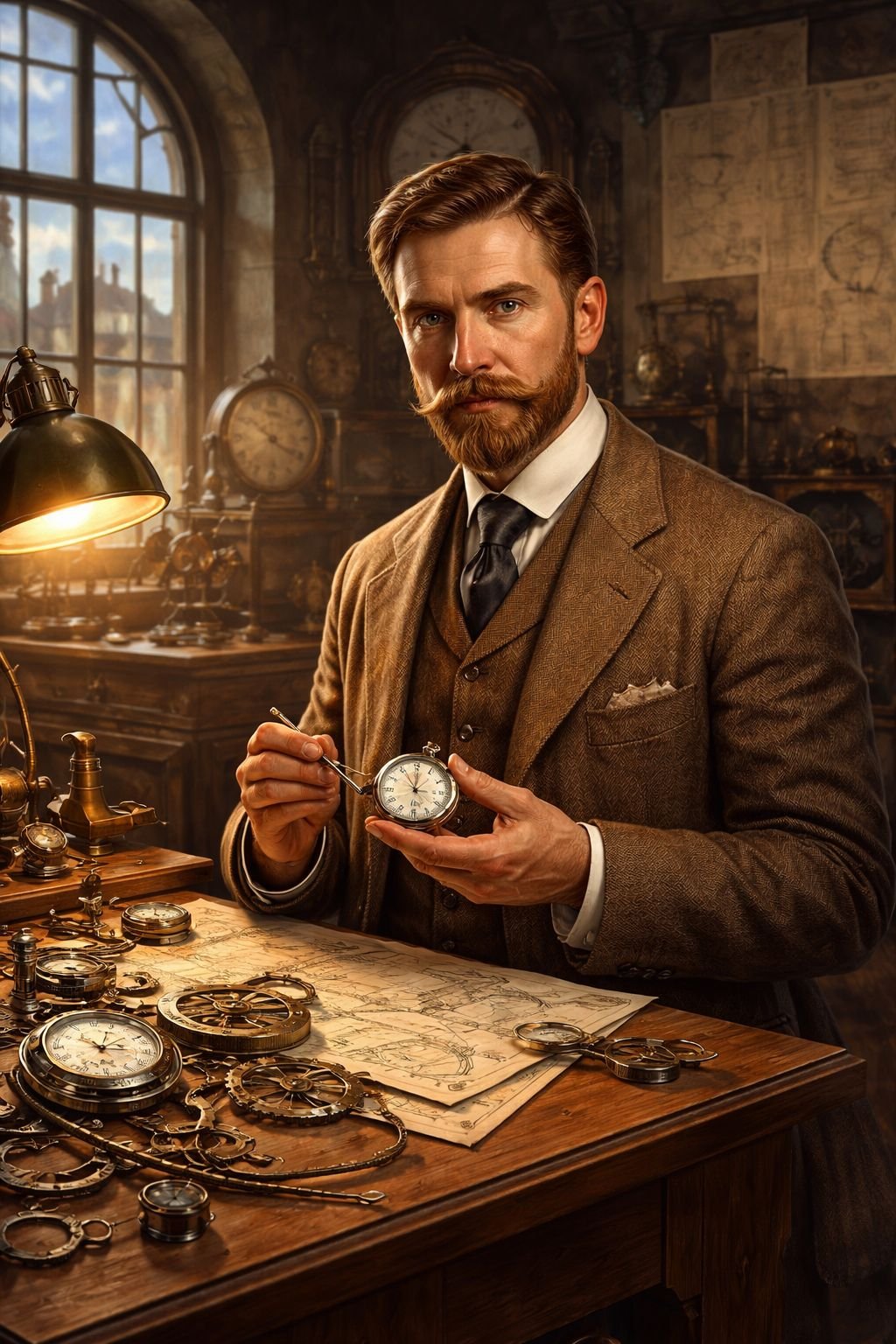
Léon Breitling was a Swiss watchmaker and the founder of the famous luxury watch brand Breitling. He is known for his important work in making chronographs, which are watches that can measure short periods of time very accurately. In the late 1800s, many watchmakers focused mainly on making beautiful pocket watches. Léon Breitling took a different path. He focused on making precise timing tools that could be used in sports, science, and industry. Because of his work, the Breitling company later became one of the most respected names in Swiss watchmaking and chronograph technology. Today, Breitling watches are known for their accuracy, strong design, and connection with aviation and professional timekeeping.
Early Life and Background
Birth and Family
Léon Breitling was born on January 27, 1860, in Switzerland. He grew up in an area where watchmaking was an important industry. Many people in this region worked in the watch trade. Living in such an environment helped him develop an interest in watches and mechanical tools at a young age.
Basic facts about Léon Breitling
| Detail | Information |
|---|---|
| Full Name | Léon Breitling |
| Birth Date | January 27, 1860 |
| Birthplace | Switzerland |
| Profession | Watchmaker and businessman |
| Known For | Founder of Breitling |
| Industry | Swiss watchmaking |
From an early age, he was interested in how watches worked and how they could measure time more accurately.
Learning Watchmaking
When he was young, Léon Breitling trained in horology, which is the art and science of making watches and clocks.
During his training he learned:
-
How watch movements work
-
How to build and repair watches
-
How to design timing instruments
-
How to improve mechanical accuracy
Unlike many watchmakers who focused on decoration, he was more interested in precision and function.
Founding the Breitling Company
Starting the Business (1884)
In 1884, Léon Breitling opened his own watch workshop in Saint-Imier. Instead of making regular pocket watches, he focused on chronographs and stopwatches. These tools were designed to measure time very accurately.
Early products of the company
| Product Type | Purpose |
|---|---|
| Chronographs | Measure elapsed time |
| Stopwatches | Used in sports timing |
| Pocket chronographs | Portable timing tools |
| Mechanical timers | Used in industrial work |
His focus on accurate timing helped his workshop grow quickly.
His Business Idea
Léon Breitling believed that watches should be useful tools, not just luxury objects. He saw that many industries needed precise timing. These included sports events, engineering work, and scientific experiments.
Industries that needed timing tools
-
Sports competitions
-
Scientific research
-
Factories and manufacturing
-
Transportation and engineering
By creating reliable chronographs, Breitling built a strong reputation for precision watches.
Read also: Louis-Ulysse Chopard
Chronograph Innovations
Early Timing Instruments
Breitling’s workshop produced many types of timing devices. These tools were used by professionals who needed accurate time measurements.
Some common instruments included:
-
Mechanical stopwatches
-
Chronograph pocket watches
-
Industrial timers
-
Sports timing devices
These products helped measure short periods of time very precisely.
Important Patent (1889)
In 1889, Léon Breitling received a patent for improvements in the chronograph mechanism.
This innovation made chronographs:
-
Easier to use
-
More reliable
-
More efficient to produce
Effects of the innovation
| Improvement | Benefit |
|---|---|
| Better chronograph mechanism | Higher accuracy |
| Simpler design | Easier manufacturing |
| Stronger reliability | Longer lifespan |
| Professional use | More industries adopted it |
This invention helped Breitling become known as a leader in chronograph technology.
Expansion of the Company
Move to a Larger City (1892)
As the business grew, Léon Breitling needed a bigger factory. In 1892, he moved the company to La Chaux-de-Fonds. This city was one of the most important centers of watchmaking in Switzerland.
Benefits of moving the company
-
Access to skilled watchmakers
-
Better production facilities
-
Strong watchmaking network
-
More opportunities for growth
The new factory allowed the company to increase production while keeping high quality.
Growth of the Brand
During the late 1800s, Breitling became famous for producing accurate timing instruments. Many professionals began using Breitling devices.
Professionals who used Breitling instruments
-
Sports timekeepers
-
Engineers
-
Scientists
-
Industrial workers
Because of its reliable products, the brand slowly gained international recognition.
Products and Market Influence
Types of Timing Tools
Breitling created several types of tools for measuring time.
Main product categories
| Product | Use |
|---|---|
| Chronograph pocket watches | Measure elapsed time |
| Mechanical stopwatches | Sports timing |
| Industrial timers | Factory processes |
| Scientific timing tools | Laboratory experiments |
These devices were trusted for their precision and durability.
Use in Professional Fields
Breitling timing tools were widely used in many industries.
Major industries using Breitling instruments
-
Sports and athletics
-
Scientific research
-
Engineering projects
-
Industrial manufacturing
By making reliable chronographs, Breitling helped improve professional time measurement.
Family Leadership
Gaston Breitling Takes Over
After Léon Breitling passed away, the company was led by his son Gaston Breitling. Gaston continued his father’s work and introduced new improvements to chronograph watches.
Contributions of Gaston Breitling
| Contribution | Result |
|---|---|
| Improved chronograph designs | Better functionality |
| Development of wrist chronographs | More practical watches |
| Business expansion | Global recognition |
He helped the company grow and innovate further.
Later Developments
Over time, the Breitling company became well known for aviation watches and professional chronographs.
Later innovations included:
-
Pilot navigation watches
-
Aviation chronographs
-
Advanced mechanical wristwatches
These developments built on the foundation created by Léon Breitling.
Death of Léon Breitling
Léon Breitling died on August 11, 1914, in La Chaux-de-Fonds, Switzerland. Although he did not live to see many later innovations of the company, his work had already created a strong base for future success.
Legacy and Impact
Contributions to Watchmaking
Léon Breitling made many important contributions to watchmaking.
His lasting achievements
-
Development of chronograph technology
-
Creation of reliable timing instruments
-
Establishment of the Breitling brand
-
Advancement of professional time measurement
Because of these contributions, he is remembered as one of the pioneers of precision chronograph watches.
Breitling Today
Today, Breitling is still one of the most respected names in the luxury watch industry.
Features of modern Breitling watches
| Feature | Description |
|---|---|
| Precision chronographs | Highly accurate movements |
| Aviation watches | Designed for pilots |
| Swiss craftsmanship | High-quality watchmaking |
| Professional tools | Designed for real-world use |
Modern Breitling watches continue to follow the original idea of combining precision, performance, and reliability.
Conclusion
Léon Breitling was a talented watchmaker and a visionary businessman. By founding Breitling in 1884 and focusing on accurate chronographs and timing instruments, he helped change the direction of the watch industry. His work showed that watches could be more than luxury accessories—they could be powerful tools for measuring time in sports, science, and industry. More than a century later, the Breitling brand continues to reflect the values that Léon Breitling believed in: precision, innovation, and Swiss craftsmanship.